
University Window Cleaning Cambridge
Need reliable university window cleaning in Cambridge without disrupting lectures, research or daily campus life? Windows Cleaning Cambridge provides planned window cleaning for academic buildings, colleges, research facilities, offices, libraries and university accommodation across Cambridge.
Every site also brings different access challenges. Historic buildings around central Cambridge also need a different approach from modern glazed research facilities in West Cambridge. For that reason, we assess the building first. We then plan the safest and most practical cleaning method around your site, working hours and academic schedule.
Need a quote for one building or a larger university estate? Request a university window cleaning site survey in Cambridge.
Ready to Get Your Windows Cleaned Properly
Send us the property address and photographs of each elevation, then we will review the information and tell you whether a site survey is needed.
Specialist Window Cleaning for Cambridge Universities and Colleges
University buildings rarely operate like standard commercial offices. Students move between lectures. Researchers also need uninterrupted access. Libraries stay busy. Accommodation blocks have privacy considerations. Historic buildings can have difficult glazing and sensitive surroundings. Facilities teams also need clear communication before work starts.
University Departments and Faculty Buildings
Faculty and departmental buildings often combine offices, teaching rooms, meeting spaces and shared entrances. Footfall can change quickly during the day. Therefore, timing matters. We can also plan window cleaning around quieter periods where the site allows it. That approach also reduces conflict with:
The goal stays simple. Clean the glazing without making window cleaning the centre of attention.
Related Window Cleaning Services
We also clean windows for schools and education buildings across Cambridge:
- Nursery Window Cleaning Cambridge
- School Window Cleaning Cambridge
- Training Centre Window Cleaning Cambridge
- College Window Cleaning Cambridge
More From Windows Cleaning Cambridge
- Residential window cleaning
- Commercial window cleaning
- Interior window cleaning
- Gutter cleaning
- Conservatory roof cleaning
- Fascia as well as soffit cleaning
- Solar panel cleaning
We cover the whole city as well as nearby villages, so see all the areas we cover.
Cambridge College Window Cleaning
Cambridge colleges also need their own approach. The city’s 31 colleges govern themselves and maintain their own facilities. They form part of collegiate Cambridge, but they do not all operate as one centrally managed estate. That also distinction matters for facilities and procurement teams.
A college may also need window cleaning across several types of property. These can include:
- Historic courts
- Libraries
- Dining areas
- Offices
- Teaching rooms
- Porters’ lodges
- Student accommodation
- Conference spaces
- Modern extensions
- Off-site residential buildings
One site may also contain glass at several heights. Access can change from one elevation to the next. For that reason, a site survey gives a much more useful answer than a generic square-metre estimate.
Research and Laboratory Buildings
Cambridge has a major research community. Research buildings can also create tighter access requirements than standard offices. Some spaces operate for long hours. Others contain sensitive work. Window cleaners must also respect restricted rooms, controlled routes and site instructions.
We also plan the window-cleaning element around the facility. We do not interfere with laboratory procedures or research equipment. Where internal glazing sits close to sensitive areas, the facilities contact should confirm access rules before work starts. That simple step also prevents confusion on the day.
Libraries, Lecture Halls and Administrative Buildings
Libraries and lecture buildings often combine tall glazing with heavy pedestrian movement. Administrative spaces may also create different challenges. In addition, staff need access throughout the working day. Reception areas also make a strong first impression. Therefore, cleaning frequency should reflect the building’s use. A prominent entrance may need more attention than a quiet upper-floor window.
Student Accommodation
University accommodation also needs careful scheduling. Residents need privacy. Access routes must stay clear. Cleaning teams should also avoid unnecessary disturbance during revision periods or early mornings. For external work, we can plan the route before arriving. For internal work, facilities teams may need to arrange room access in advance.
Sports, Conference and Support Buildings
Academic estates extend beyond lecture rooms. Cambridge institutions can also include sports facilities, event spaces, offices, meeting rooms and other support buildings. Each property serves a different purpose. The cleaning schedule should reflect that. A conference venue may need attention before a major event. A sports facility may also require a different frequency. A back-office building may need fewer visits.
Window Cleaning for Cambridge’s Diverse Academic Estate
Cambridge does not have one single university district. Academic buildings spread across the city. They range from historic central sites to modern research campuses. The University’s own Facilities Management team lists responsibility across locations including Old Schools, Old Press and Mill Lane, Downing Site, New Museums Site, Sidgwick Site, West Cambridge, Madingley Rise and Cambridge Biomedical Campus. This geography also changes how facilities teams should plan window cleaning.
Historic and Conservation-Sensitive Academic Buildings
Central Cambridge contains some of the country’s most recognisable academic architecture. Areas around King’s Parade, Trinity Street, Silver Street, Senate House and the historic college courts bring very different access conditions from a modern business park. Older buildings can have:
- Traditional window layouts
- Restricted vehicle access
- Narrow entrances
- Sensitive stonework
- Enclosed courts
- High pedestrian footfall
- Difficult ladder positions
- Limited equipment space
The best cleaning method also depends on the actual building. A historic appearance does not automatically also require one particular technique. Instead, we check the glazing, access points and surrounding surfaces first.
Protecting the Building Around the Window
Window cleaning affects more than glass. Frames, ledges, nearby masonry and access routes all matter. That is especially important around older Cambridge property. We also avoid treating delicate surroundings like a modern industrial façade. Where the building has conservation requirements, the facilities or estates team should flag them during the survey.
Modern University and Research Buildings
Newer academic buildings create another set of challenges. Large glazed sections can extend across several floors. Some buildings also have recessed glass, atriums or windows above entrances. Ground-level access can also help. However, no single system suits every elevation. Our first question remains: What is the safest practical way to reach this glass? That question comes before speed.
Multi-Building University Campuses
A university estate may also contain five buildings. Another site may contain fifty. Cleaning each building as an unrelated job can also create unnecessary administration. A better plan groups the work logically. For example:
| Building Type | Typical Priority | Planning Consideration |
|---|---|---|
| Main entrance | High | Visitor impression and footfall |
| Teaching block | Medium to high | Lecture timetable |
| Research building | Site-specific | Access controls |
| Library | Medium | Student use and opening hours |
| Accommodation | Variable | Privacy and room access |
| Historic building | Site-specific | Access and building sensitivity |
| Administration | Medium | Working hours |
| Conference space | Event-led | Event calendar |
A planned contract can then divide the estate into sensible cleaning zones. That also makes scheduling easier for facilities teams. It can also reduce repeated setup work.
Window Cleaning Around the Cambridge Academic Calendar
University cleaning cannot ignore the calendar. Cambridge’s academic year contains Michaelmas, Lent and Easter terms. Full Term also creates concentrated periods of undergraduate teaching. Postgraduate activity continues throughout the wider academic year.
That difference matters. A university does not simply become empty outside undergraduate Full Term. Research continues. Staff remain on site. Conferences take place. Postgraduate work continues. Maintenance projects also compete for access.
Cleaning During University Vacations
Vacation periods can also create useful opportunities for larger cleaning programmes. However, facilities managers should never assume every building becomes quiet. We recommend checking:
- Department opening hours
- Research schedules
- Accommodation occupancy
- Conference bookings
- Building works
- Security access
- Deliveries
- Internal room availability
Planning those details early also makes the clean easier to manage.
Early-Morning and Out-of-Hours Cleaning
Busy entrances can also make daytime work impractical. Earlier cleaning may reduce pedestrian conflict. Out-of-hours work may also suit some departments. However, the safest time depends on the building. Darkness, security arrangements and access restrictions can also change the risk profile. We also agree the timing before the job starts.
Working Around Lectures and Research
A cleaning schedule should support the site. It should not fight against it. Where possible, we identify busy periods during the initial discussion. We can then plan higher-traffic elevations for quieter times. The same principle applies to internal cleaning. Rooms with fixed teaching schedules also need different access from open circulation areas.
Exam Periods
Exam periods can also increase sensitivity around noise and movement. Window cleaning close to examination rooms may need tighter scheduling. Facilities teams should identify those locations in advance. We can then adjust the route.
Open Days and University Events
Presentation matters before major visitor days. Cambridge regularly hosts undergraduate Open Days and college events for prospective students and families. Similar preparation may apply before:
- College Open Days
- Conferences
- Degree ceremonies
- Alumni events
- Public lectures
- Formal dinners
- Recruitment events
- Department visits
A planned pre-event clean can also focus on the areas visitors notice first. That often means entrance glazing, ground-floor windows and prominent façades.
University Window Cleaning Methods
The building should determine the method. Not the other way around. Cambridge commercial competitors already use several systems for difficult access. Local services advertise water-fed poles, MEWPs and rope-access methods for commercial buildings. A professional site plan should therefore consider more than height. It should also consider access space, pedestrians, glazing design and surrounding property.
Pure-Water Water-Fed Pole Cleaning
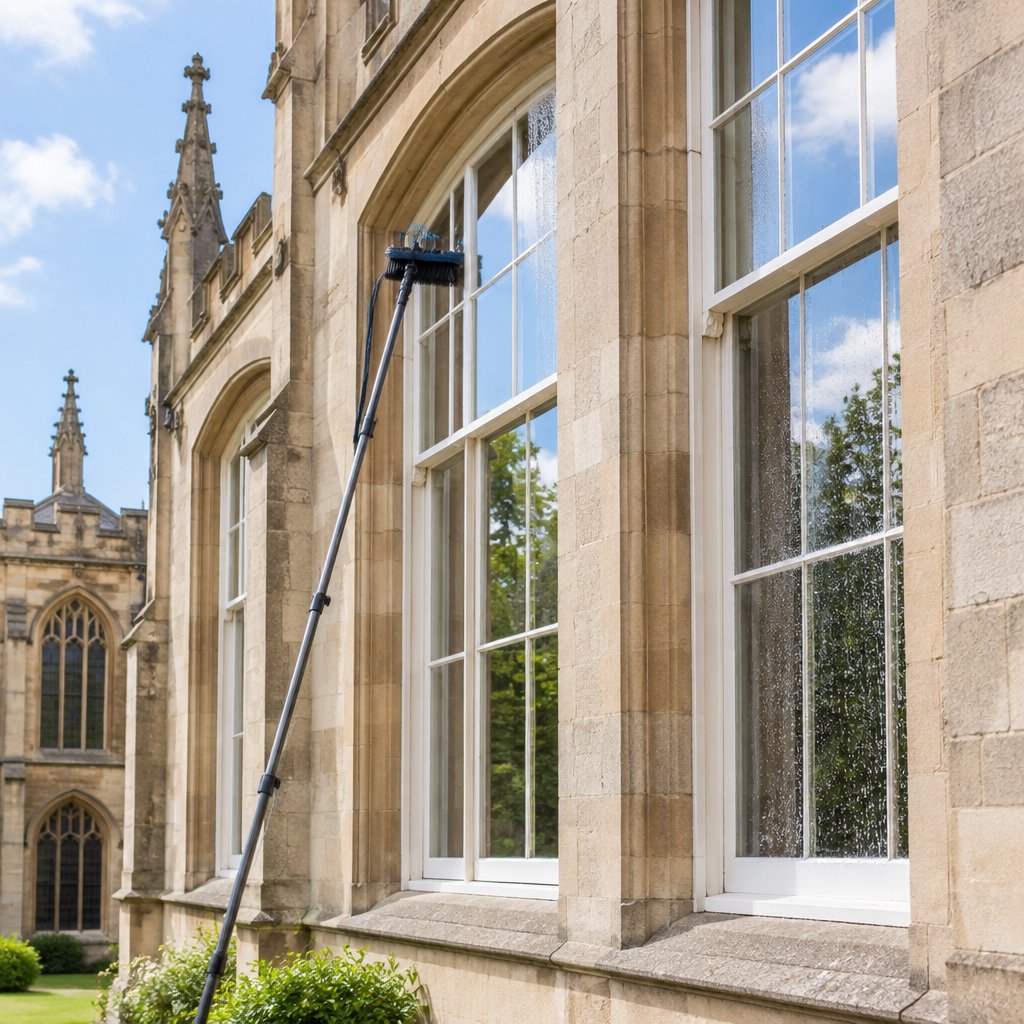
Water-fed pole systems can also clean many external windows from ground level. The operative also works with an extendable pole. Purified water travels through the system to the brush head. Furthermore, this method can reduce the need for ladders on suitable buildings. It can also reach frames and surrounding window areas. Local Cambridge commercial cleaners already use this method extensively for higher external glazing. The system still needs proper planning. Trees, projections, courtyards and restricted ground access can also limit reach.
Traditional Internal Window Cleaning
Some internal windows also suit traditional hand cleaning. This method can work well for accessible glass. It also gives close control around internal surfaces. Before entering offices or occupied rooms, we confirm access arrangements. That also keeps the process organised.
High-Reach Window Cleaning
Height alone does not decide the method. The position of the glass also matters too. A relatively low window can still prove difficult when it sits above:
- A canopy
- A roof section
- A courtyard
- Landscaping
- An entrance
- A stairwell
- A restricted service area
We also assess those obstacles during the survey.
MEWP and Powered Access
Some glazing may require powered access. A Mobile Elevating Work Platform can provide access where ground conditions and site layout allow it. However, MEWP work needs suitable space. Vehicle movements also need control. For busy academic sites, timing becomes particularly important.
Rope Access and Abseiling
Some façades may also need specialist rope access. Cambridge commercial providers already use rope-access systems where other methods do not suit the building. This work also requires specialist competence. We only arrange rope access through a suitably qualified and approved specialist.
How We Select the Right Access Method
We consider:
- Building height
- Window position
- Ground conditions
- Pedestrian movement
- Vehicle access
- Glazing design
- Nearby structures
- Site restrictions
- Internal access
- Working hours
Then we choose the practical approach. That process also helps avoid overcomplicated work.
Health and Safety for University Window Cleaning
Universities manage busy workplaces. Any contractor working on site also needs to recognise that. Window cleaning can involve height, equipment, water, pedestrian routes and building access. Good planning controls those issues before the first pane gets cleaned.
Site-Specific Risk Assessment
We start with the site. A generic risk assessment cannot identify every local issue. For example, a Downing Site building may create different access conditions from a property near West Cambridge. A city-centre college court can create another set of constraints. Site-specific checks may cover:
- Working at height
- Public access
- Student movement
- Slips and trips
- Equipment positioning
- Vehicle routes
- Restricted areas
- Fragile surfaces
- Weather
- Internal access
- Emergency routes
RAMS for Planned Window Cleaning
Commercial facilities teams often require RAMS. RAMS means Risk Assessments and Method Statements. These documents explain identified risks and how the work will proceed. Competitors serving the Cambridge commercial market already place strong emphasis on risk assessments, method statements, training and compliance documentation. In addition, that makes clear paperwork an important trust signal.
Working at Height
We aim to reduce unnecessary also work at height. Ground-based methods can also often help. However, the building must allow them. Where specialist access becomes necessary, the competent access method should match the task.
Pedestrian and Student Safety
Cambridge campuses can become busy within minutes. A lecture finishing can also change footfall immediately. Therefore, work zones need sensible positioning. Possible controls include:
- Clear working areas
- Equipment management
- Appropriate signage
- Controlled access where required
- Timing also work outside peak movement
- Coordination with site staff
The exact controls depend on the location.
Insurance and Operative Training
Facilities managers should verify contractor credentials before appointment. Your published page should state only current facts. Include the following when you can prove them:
- Public liability insurance
- Employer’s liability insurance
- Working-at-height training
- IPAF certification
- IRATA certification
- SafeContractor accreditation
- Federation membership
- Relevant health and safety training
Do not copy competitor accreditations. Use your own evidence.
Documentation for Facilities and Procurement Teams
A commercial client may need more than a quote.
Documents We Can Provide Where Applicable
- Window cleaning proposal
- Service specification
- Cleaning schedule
- Risk assessment
- Method statement
- Insurance documentation
- Training evidence
- Access plan
- Site notes
- Contact details
Before the First Scheduled Clean
Confirm the agreed scope. Confirm access. Confirm the site contact. Check any timetable changes. Review unusual building restrictions. That short checklist also prevents many avoidable delays.
Our University Window Cleaning Process
Facilities managers also need a predictable process. We also keep it clear.
1. Tell Us About the Site
Send us the building address and a short description. Include the number of buildings where possible. Photos can also help with the initial discussion.
2. Arrange a Site Survey
Complex university buildings deserve a proper look. We also inspect the accessible elevations. We also discuss internal requirements.
3. Assess Access and Risk
Next, we identify practical access methods. We also note high-footfall areas. We also flag restricted zones.
4. Define the Scope
Not every window needs the same frequency. The written scope should show what the contract covers. That reduces misunderstandings later.
5. Agree the Cleaning Schedule
We also work around the needs of the property. A schedule might use:
- Monthly visits
- Every two months
- Quarterly cleaning
- Termly cleaning
- Twice-yearly cleaning
- Annual specialist cleaning
- One-off cleaning
Frequency also depends on the site.
6. Complete the Window Clean
The team follows the agreed method. Where conditions change, the operative should raise the issue rather than improvise around an unsafe obstacle.
7. Review the Site
Larger contracts also benefit from periodic review. Buildings change. Access changes. Construction work starts. Departments move. A cleaning plan should adjust when the estate changes.
How Often Should University Windows Be Cleaned?
There is no correct frequency for every university building. A window beside a busy Cambridge road will also collect dirt differently from glazing inside a protected courtyard. A visitor-facing entrance also has a different presentation role from an upper-floor service area. Consider these factors:
- Traffic pollution
- Trees
- Bird activity
- Building orientation
- Rain exposure
- Construction nearby
- Student footfall
- Window height
- Building use
- Event programme
- Internal fingerprints
- Required presentation standard
Example Cleaning Frequencies
| Area | Possible Frequency | Why |
|---|---|---|
| Main entrance glazing | Monthly or as needed | Heavy visibility |
| Ground-floor office windows | 1–2 monthly | Regular presentation |
| Teaching buildings | Termly or quarterly | Balance access and appearance |
| Upper external glazing | Quarterly or biannual | Lower touch frequency |
| Internal glass | Site-specific | Depends on use |
| Accommodation | Termly or planned | Access and privacy |
| Event spaces | Event-led | Presentation requirement |
| Difficult high-level glazing | Planned cycle | Access cost and setup |
These are planning examples. A survey also gives a better recommendation.
University Window Cleaning Costs in Cambridge
University window cleaning does not have one sensible flat price. Furthermore, the cost depends on the work required. A simple two-storey department building could also need a straightforward approach. A large multi-building estate may require several methods.
What Affects the Price?
The main factors include:
- Number of windows
- Number of buildings
- Building height
- Window size
- Access difficulty
- Internal cleaning
- External cleaning
- Cleaning frequency
- Specialist equipment
- Parking
- Vehicle access
- Pedestrian management
- Out-of-hours work
- Historic building constraints
- Contract length
Why a Site Survey Helps
A site survey also reduces guesswork. It also lets us identify access problems before pricing the work. That matters on academic estates. One elevation may also take little time. Another could require a completely different access plan. A clear survey also creates a better quote. It also gives the facilities manager a more realistic service specification.
Need an accurate price? Request a university window cleaning survey in Cambridge.
University Window Cleaning Across Cambridge
We support university and education properties across Cambridge and surrounding areas within our service range. Academic activity stretches far beyond King’s Parade. That wider geography should also shape the service.
Cambridge City Centre
Central Cambridge includes historic university and college property around areas such as:
- King’s Parade
- Trinity Street
- St Andrew’s Street
- Silver Street
- Pembroke Street
- Downing Street
- Mill Lane
These streets can have heavy pedestrian and cycle traffic. Vehicle access can also become limited. Careful scheduling helps.
Sidgwick Site and West Road
The Sidgwick area contains major humanities and social-science facilities. Buildings sit close to busy pedestrian and cycle routes, so that makes access planning important. The University’s Estates team identifies Sidgwick as one of the sites served through its facilities-management structure.
Downing Site
Downing Site also sits close to central Cambridge. It contains academic and research activity within a compact area. Facilities teams should consider pedestrian movement, vehicle access and department schedules when arranging exterior work.
New Museums Site
New Museums Site sits within a busy central location. Its position also creates obvious logistical considerations. Cleaning contractors need to think about access before arriving.
West Cambridge
West Cambridge has a different physical character. Modern academic and research buildings also create larger façades and broader campus layouts. Some properties may also allow easier equipment positioning. Others also create high-level glazing challenges.
Madingley Road and Madingley Rise
Academic and research property continues west along the Madingley Road corridor. These locations often differ from central Cambridge in access and surrounding space. Again, the building should also dictate the cleaning method.
Cambridge Biomedical Campus
The Cambridge Biomedical Campus forms another major research and academic area. The University lists the campus within its facilities-management coverage. Research environments demand clear coordination. Facilities contacts should confirm access restrictions before work begins.
Cambridge Colleges
Cambridge’s 31 colleges spread across and around the city. The University notes that all college locations also sit within three miles of Cambridge city centre. Some occupy centuries-old central sites. Others have more modern campuses. That also diversity makes college window cleaning in Cambridge a specialist commercial service in its own right.
Important: References to Cambridge academic locations describe our service geography and local context. They do not imply an official relationship with the University of Cambridge or any individual college unless we state that relationship separately.
Why Choose Windows Cleaning for University Window Cleaning in Cambridge?
A facilities manager needs more than clean glass. They need a contractor who turns up prepared. They also need clear communication.
Local Cambridge Knowledge
Cambridge presents unusual access conditions. Cycles fill many streets. Pedestrian traffic can also become intense. Historic streets restrict larger vehicles. Academic activity also changes throughout the year. Local planning also helps us account for those realities.
Commercial Approach
University work needs structure. We agree:
- Scope
- Access
- Frequency
- Timing
- Site contacts
- Building priorities
That creates accountability.
Flexible Scheduling
Teaching does not follow normal office patterns. Research does not stop at 5pm. Therefore, we discuss timing rather than assuming every site suits the same schedule.
Clear Communication
Facilities teams should also know what happens next. If access changes, we communicate. If a window cannot be reached safely, we explain why. If the scope changes, we agree it before adding work.
Planned Maintenance
Regular cleaning can reduce the scramble before important events. It also keeps presentation standards more consistent throughout the year. For larger estates, planned maintenance also gives facilities teams more control.
A Practical Example of Multi-Building Window Cleaning
A large Cambridge site can contain several architectural styles. In addition, that creates a useful lesson for university estates. On a multi-building site, a sound plan starts with an audit of access points and safety issues, so that the right equipment is matched to each part of the estate. Some areas used ground-based systems, while others required powered access.
The principle matters. Do not force one cleaning method across an entire campus. Survey the estate. Group similar buildings. Identify difficult elevations. Then create the schedule.
Related University and Commercial Window Cleaning Services
A university estate may also need several related services. Where available, link this page to relevant service pages. Useful internal links include:
- Commercial Window Cleaning Cambridge
- College Window Cleaning Cambridge
- School Window Cleaning Cambridge
- Laboratory Window Cleaning Cambridge
- Office Window Cleaning Cambridge
- High-Level Window Cleaning Cambridge
- Heritage Building Window Cleaning Cambridge
- Student Accommodation Window Cleaning Cambridge
- Retail Window Cleaning Cambridge
- Gutter Cleaning Cambridge
These links also help users reach the right service. They also make the site’s Cambridge commercial cleaning structure easier to understand.