
Three-Storey House Window Cleaning Cambridge
Top-floor windows are easy to ignore. They are also the hardest windows on the house to clean safely.
A short ladder will still not reach them. An extension, conservatory also or sloping roof may block the glass. Narrow Cambridge gardens also and side passages can make access even more difficult.
Windows Cleaning Cambridge provides three-storey house window cleaning across Cambridge and nearby areas. We clean high exterior windows using professional reach equipment and purified water where the property allows.
Ready to Get Your Windows Cleaned Properly
We assess the building before confirming the work. That means checking the height, ground conditions, window position and access to the front and rear of the house before we quote.
Our service can cover:
- Third-floor exterior glass
- Lower-floor windows
- Accessible window frames
- Window sills and ledges
- Windows above extensions
- Glazed exterior doors
- Dormer and recessed windows
- One-off or regular cleaning
Send us your postcode and clear photographs of the property, then we will check access. We will then review the access and provide a straightforward quote.
| Service detail | What to expect |
| Property type | Three-storey houses and townhouses, as well as tall residential properties |
| Cleaning method | High-reach water-fed pole cleaning where suitable |
| Water | Purified water for a clear, residue-free rinse |
| Areas cleaned | Glass and accessible frames, as well as sills |
| Quote process | Send your postcode and property photographs |
| Service area | Cambridge and selected surrounding CB postcodes |
/ro/ro
How We Clean Third-Floor Windows Safely
he safest method depends on the height, building design and space around the house. A window that appears easy to reach from indoors may still sit directly above a conservatory outside. A top-floor dormer may also be hidden behind guttering. A rear window may therefore only be accessible through a narrow passage.
We normally therefore aim to clean high exterior windows from ground level.
The Health and Safety Executive states that window-cleaning work should avoid working at height where reasonably practical, so it gives telescopic water-fed poles as one example of how high windows can be cleaned from the ground.
This approach reduces unnecessary work at height while allowing us to reach many third-floor windows safely.
High-Reach Water-Fed Pole Cleaning
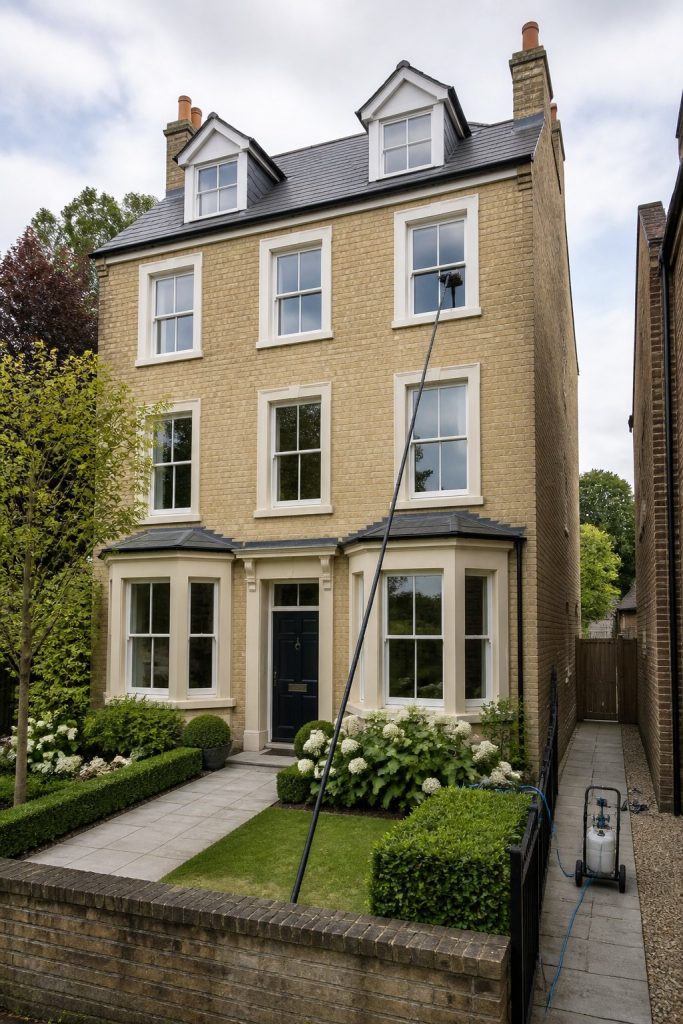
A water-fed pole then carries purified water to a specialist brush at the top of the pole.
The brush first then loosens dirt from the glass, frame edges and seals. The purified water then rinses the surface. The window is then left to dry naturally.
This method works well for many three-storey properties because it can reach upper windows without placing a ladder against every frame.
It also allows us to clean more than the centre of the pane. In addition, where accessible and in suitable condition, we clean the outer frame and sill as part of the agreed service.
Related Window Cleaning Services
We also clean windows for every type of home in Cambridge:
- Two-Storey House Window Cleaning
- Bungalow Window Cleaning
- Townhouse Window Cleaning
- Country House Window Cleaning
- Victorian Terrace Window Cleaning
- Eco-Friendly Home Window Cleaning
- Sash Window Cleaning
- Flat Window Cleaning
More From Windows Cleaning Cambridge
- Residential window cleaning
- Commercial window cleaning
- Interior window cleaning
- Gutter cleaning
- Conservatory roof cleaning
- Fascia as well as soffit cleaning
- Solar panel cleaning
We cover the whole city as well as nearby villages, so see all the areas we cover.
Apartment Window Cleaning
Farmhouse Window Cleaning
Mansion Window Cleaning
Thatched Cottage Window Cleaning
Other Services
What Our Three-Storey Window Cleaning Service Includes
A useful quote should also tell you exactly what will be cleaned.
Our standard exterior service generally can include the glass, accessible outer frames and accessible sills of the agreed windows.
The final scope depends on the property and will be confirmed before the visit.
| Area | Standard exterior service | Separate assessment may be needed |
| Exterior window glass | Yes | Heavy building residue |
| Accessible frames | Yes | Loose paint or damaged timber |
| Accessible sills | Yes | Deep staining or restoration |
| Third-floor windows | Yes, where safely reachable | Specialist access |
| Rear windows | Yes, when included in the quote | No safe rear access |
| Glazed exterior doors | Can be included | Interior door glass |
| Windows above extensions | Subject to assessment | Obstructed working angle |
| Dormer windows | Subject to assessment | Recessed or roof-facing glass |
| Interior glass | Separate service | Tall internal stairwell glass |
| Conservatory roof | Separate service | Fragile or difficult roof sections |
| Paint, cement or silicone | Not a standard clean | Specialist removal |
Why We Use Purified Water
Ordinary tap water still contains dissolved minerals.
When tap water dries on glass, those minerals can remain on the surface. This may therefore leave pale spots or streaks.
Cambridge Water also confirms that all the water it supplies is classed as hard. It contains naturally occurring minerals such as calcium and magnesium.
Purification therefore removes the dissolved mineral content from the water used for the final rinse. Then, once the dirt has been removed, the remaining droplets can dry without leaving the same mineral residue.
That is why the glass may still look wet when we finish.
The window should therefore not be wiped with a household cloth after a purified-water clean. Doing so can transfer dust, detergent or fabric residue back onto the glass.
We Check the Whole Working Area
Height is only one part of the assessment, so we look at the whole site.
Before cleaning, we look for:
- Uneven or sloping ground
- Loose paving
- Narrow paths
- Parked vehicles
- Overhead cables
- Fragile roof surfaces
- Trees and shrubs
- Conservatories
- Ground-floor extensions
- Balconies and railings
- Shared access routes
- Areas used by children or pets also
Long poles need room to move, especially in narrow gardens. A clear position beneath the window therefore helps the cleaner control the brush and rinse the glass properly.
Where the normal method is not safe or effective, we will explain the limitation rather than take an unnecessary risk.
Glass, Frames and Sills
Cleaning therefore only the centre of the glass can leave the window looking unfinished.
Dust and cobwebs gather around frame edges, especially in late summer. Dirt also builds up on sills. Rain can also wash grime from an unclean frame back onto the glass.
We therefore clean accessible exterior frames and sills when they form part of the quote.
A normal window clean will still not repair:
- Faded uPVC
- Oxidised frames
- Peeling paint
- Rotten timber
- Cracked seals
- Scratched glass
- Failed double glazing
- Permanent mineral damage
Cleaning removes surface dirt. It does not restore damaged materials.
First Cleans
A first clean often takes longer than a regular maintenance visit.
Windows that have not been cleaned for months may hold compacted dirt around the seals. Bird mess may also need soaking. Old detergent residue can also continue to run from the frame after the first rinse.
We account for the condition of the windows when preparing the quote.
Then, once the heavy build-up has been removed, regular visits are usually quicker and help stop grime from collecting around the upper frames again.
Interior Window Cleaning
Interior window cleaning can be added when arranged in advance.
Inside work also requires access to each room. Curtains, blinds, ornaments and furniture may need to be moved away from the windows.
Interior cleaning may include:
- Inside glass
- Internal frames
- Internal sills
- Patio and French doors
- Accessible stairwell windows
- Interior conservatory glass
We will confirm which internal windows can be reached safely before work begins.
Difficult Windows Above Extensions, Conservatories and Dormers
Many three-storey homes have also upper windows that do not sit directly above open ground.
These are especially often the windows homeowners find most frustrating.
Windows Above Ground-Floor Extensions
A rear kitchen extension can also push the cleaner several metres away from the wall.
That therefore changes the angle needed to reach the upper glass. A deep extension may also place the top window partly behind the roofline.
When requesting a quote, send:
- For example, one photograph of the full rear elevation
- Then one photograph from the left side
- Finally, one photograph from the right side
- A clear view also of the ground behind the extension
- A photograph also of any narrow access route
Do not send only a close-up of the dirty window, because we need context. We need also to see what sits beneath it.
Flat roofs should not be treated as working platforms unless they have been designed and assessed for that use. We will therefore not stand on an extension roof simply to reach one pane.
Windows Above Conservatories
Conservatory roofs also create a similar access problem.
The glass or polycarbonate panels may be fragile. Gutters can also block the pole angle. Leaning equipment against the structure can cause damage.
We first therefore check whether the upper window can be reached from solid ground beyond the conservatory. Side access may also provide a better angle.
When no safe ground-level position exists, we will discuss what can and cannot be included.
Dormer and Recessed Windows
Dormer windows may also sit behind:
- Roof tiles
- Guttering
- Deep ledges
- Decorative timber
- Sloping roof sections
The brush must therefore make proper contact with the glass. Reaching the height alone is not enough.
Some dormer windows can still be cleaned effectively with a water-fed pole. Others have an angle or recess that prevents a full clean from the ground, because angle matters too.
Roof windows may also sometimes be easier to clean from inside, depending on how they open.
Narrow Rear Access
However, access is a common issue in Cambridge.
Terraced houses around Mill Road, Romsey and Petersfield may also have narrow passages or no direct route to the rear garden. Some properties therefore require access through the house. In addition, others share an alley with neighbouring homes.
Tell us before booking when:
- There is no side gate
- Access is also through the property
- The passage is unusually narrow
- The gate is locked
- A neighbour controls the route
- The garden is shared
- Equipment must also pass down steps
- The rear area also contains fragile paving or planting, for example.
A photograph also of the access route helps us arrive with the right plan.
How to Get an Accurate Quote Faster
Send full property photographs rather than individual window close-ups.
A useful message might read:
Three-storey townhouse in Trumpington. Nine windows at the front and ten at the rear. Two top-floor windows are also above a flat-roof extension. There is side-gate access. Exterior cleaning only.
That therefore gives us enough detail to understand the main access issues.
A message saying only “How much for a three-storey house?” does not show the size or layout of the job.
One-Off and Regular Cleaning
You can also request a one-off clean or ask about regular visits.
A one-off clean, however, may suit:
- Preparing a home for sale
- Moving into a property
- End-of-tenancy cleaning
- A family event
- A long-overdue clean
- Cleaning after garden or exterior work
Regular cleaning helps prevent heavy build-up on upper frames and sills.
The right frequency depends on the property. Homes close to busy roads, mature trees, open spaces or ongoing construction may collect dirt more quickly.
Three-Storey Window Cleaning Across Cambridge
Windows Cleaning Cambridge provides quotes across the city and selected surrounding areas.
Cambridge City Council’s ward map includes areas such as Abbey, Arbury, Cherry Hinton, East Chesterton, King’s Hedges, Petersfield, Queen Edith’s, Romsey, Trumpington and West Chesterton.
Our service area can include:
- Cambridge city centre
- Romsey
- Nearby CB postcodes
Send your postcode to confirm availability.
How the Service Works
We keep the quote and booking process clear.
1. Send Your Postcode and Photographs
Start with the Cambridge postcode and a few useful images.
Send photographs showing:
- The complete front of the house
- The complete rear of the house
- Any side access
- Extensions or conservatories
- Dormers and roof windows
- Balconies or railings
- The ground beneath the upper windows
Include whether you need exterior-only or interior and exterior cleaning.
2. We Review the Property
We assess the height, window layout and access.
We may need to know:
- How many windows require cleaning
- Whether the rear gate opens
- Whether access is through the house
- Whether cars park below the windows
- Whether building work has taken place
- Whether frames are uPVC, aluminium or timber
- Whether any window is damaged or does not close
If photographs do not provide enough information, the property may need an on-site assessment.
3. We Confirm the Scope
The quote will set out the agreed work.
It should be clear whether the service includes:
- Front and rear windows
- Frames and sills
- Exterior doors
- Windows above extensions
- Dormer windows
- Interior glass
- A one-off or regular clean
This avoids confusion on the day.
4. Prepare the Property
Before we arrive:
- Close every window
- Unlock the agreed gate
- Move fragile pots from the working area
- Remove washing from outdoor lines
- Secure pets
- Move vehicles when requested
- Tell us about loose paving
- Identify damaged or poorly closing windows
A clear route protects your belongings and gives the cleaner enough room to control the equipment.
5. We Clean and Check the Windows
We usually start with the highest windows.
The brush loosens the dirt. Purified water rinses the glass, frame edges and accessible sill. Lower windows are then cleaned as agreed.
We check the elevation from the ground before packing away.
Some faults become more visible once the glass is clean. These can include scratches, failed seals, fogging between panes or damage within the frame. We will point out obvious problems where practical.
Three-Storey Window Cleaning Prices in Cambridge
Three-storey houses vary too much for one flat price to be accurate.
A modern townhouse with clear front and rear access may take less time than a similar-sized home with a conservatory, dormers and no side gate.
We price the property according to the work involved.
What Affects the Quote?
| Pricing factor | Why it matters |
| Number of windows | More glass requires more cleaning and rinsing |
| Window size | Large panes take longer to brush correctly |
| Property height | Taller elevations need greater reach and control |
| Front and rear access | Restricted routes increase setup time |
| Extensions | They may block the direct pole angle |
| Conservatories | Fragile roofs can limit access |
| Dormer windows | Recessed glass can be harder to reach |
| Window condition | Heavy dirt may require repeated cleaning |
| Frame condition | Built-up grime around seals takes longer |
| First clean | Neglected windows need more work |
| Interior cleaning | Indoor preparation and access add time |
| Parking | Distance from the vehicle can affect setup |
| Building residue | Paint and cement, as well as silicone need separate treatment |
Central Cambridge
Central properties can have restricted parking, shared entrances and limited equipment space.
Homes near Parker’s Piece, Midsummer Common, Jesus Green or the historic centre may need more careful planning than a property with a private drive.
Tell us about:
- Permit parking
- Loading restrictions
- Courtyards
- Pedestrian access
- Flats above commercial premises
- Shared gardens
- Managed-building rules
Mill Road, Romsey and Petersfield
These areas contain many terraced and tightly spaced properties.
Rear windows may sit above later extensions. Side access can be narrow or unavailable. In some cases, all equipment must pass through the house.
Clear access photographs help us decide whether the rear elevation can be included.
Chesterton and North Cambridge
Properties around Chesterton and Cambridge North can range from older terraces to modern three-storey homes.
Newer homes may have balconies, large panes or set-back top floors. Older properties may have timber frames and narrow garden access.
Trumpington and Queen Edith’s
Modern townhouses in and around Trumpington often use height to make the most of narrower plots.
Top-floor bedroom windows may sit above kitchen extensions or small rear gardens. Properties near Addenbrooke’s can also have busy parking conditions during the day.
Newnham and West Cambridge
Mature gardens can make access more complex.
Trees, established borders, garden rooms and deep extensions may stand between the cleaner and the upper windows. Older timber frames also need a careful approach when paint or putty has started to fail.
Eddington, Girton and Nearby Developments
Modern tall homes can include:
- Large upper panes
- Juliet balconies
- Recessed windows
- Roof terraces
- Narrow side routes
- Shared parking courts
Photographs should show the complete elevation and the space beneath each upper window.
Why Choose Windows Cleaning Cambridge?
A good three-storey window clean starts before the brush touches the glass.
It starts with an honest assessment of the property.
Clear Quotes
We define the agreed work before the visit.
You will know whether the quote covers the front, rear, frames, sills and difficult upper windows.
Safety-Led Access Decisions
We use a ground-level method where it is suitable.
We do not force the equipment into an unsafe position or stand on fragile roofs to reach one pane.
Practical Local Knowledge
Cambridge properties present a wide mix of access problems.
These include narrow passages around Mill Road, mature gardens in Newnham, modern townhouse layouts in Trumpington and restricted parking near the city centre.
We consider these details when reviewing the job.
Care Around Your Property
Long equipment must be controlled carefully.
We work around planting, outdoor furniture, lighting, parked vehicles and exterior fittings. A clear working area helps us protect them.
Straight Answers About Limitations
Not every mark is surface dirt.
We will not describe scratches, failed glazing or permanent mineral damage as a cleaning failure. We will also explain when a window cannot be reached effectively using the planned method.
That honesty helps you make an informed decision before booking.
A Common Three-Storey Cambridge Access Problem
Consider a typical modern townhouse with three floors.
The front elevation has a clear pavement or driveway. The third-floor windows can be reached directly from solid ground.
The rear is more complicated.
A flat-roof kitchen extension sits beneath two bedroom windows. A narrow path runs beside the extension. Planting reduces the available working space, and a small conservatory blocks part of the angle.
The assessment would consider:
- Whether the upper panes can be reached from beyond the extension
- Whether the pole has enough room to move safely
- Whether the conservatory blocks the brush angle
- Whether side access provides a better position
- Whether the ground is level and stable
- Whether any window needs to be cleaned from inside
The quote would then separate straightforward windows from any pane that needs another approach.
This is why property photographs matter. Two houses with the same number of windows can require very different amounts of work.